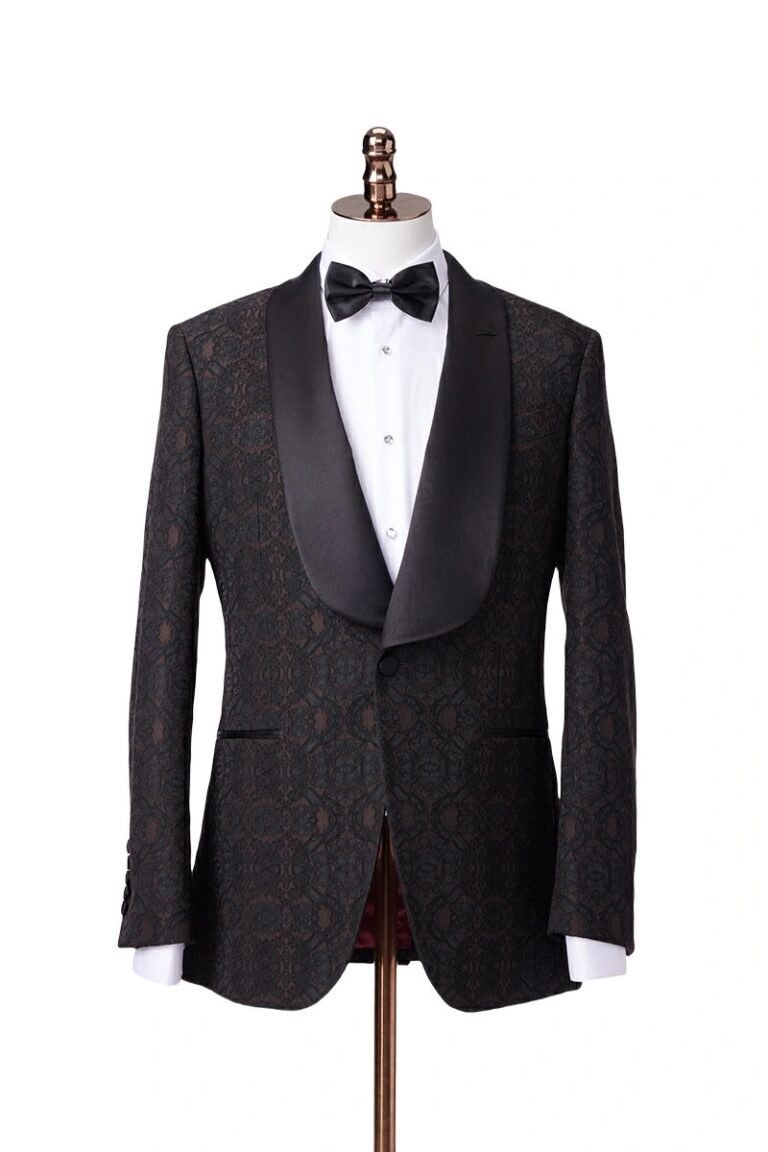
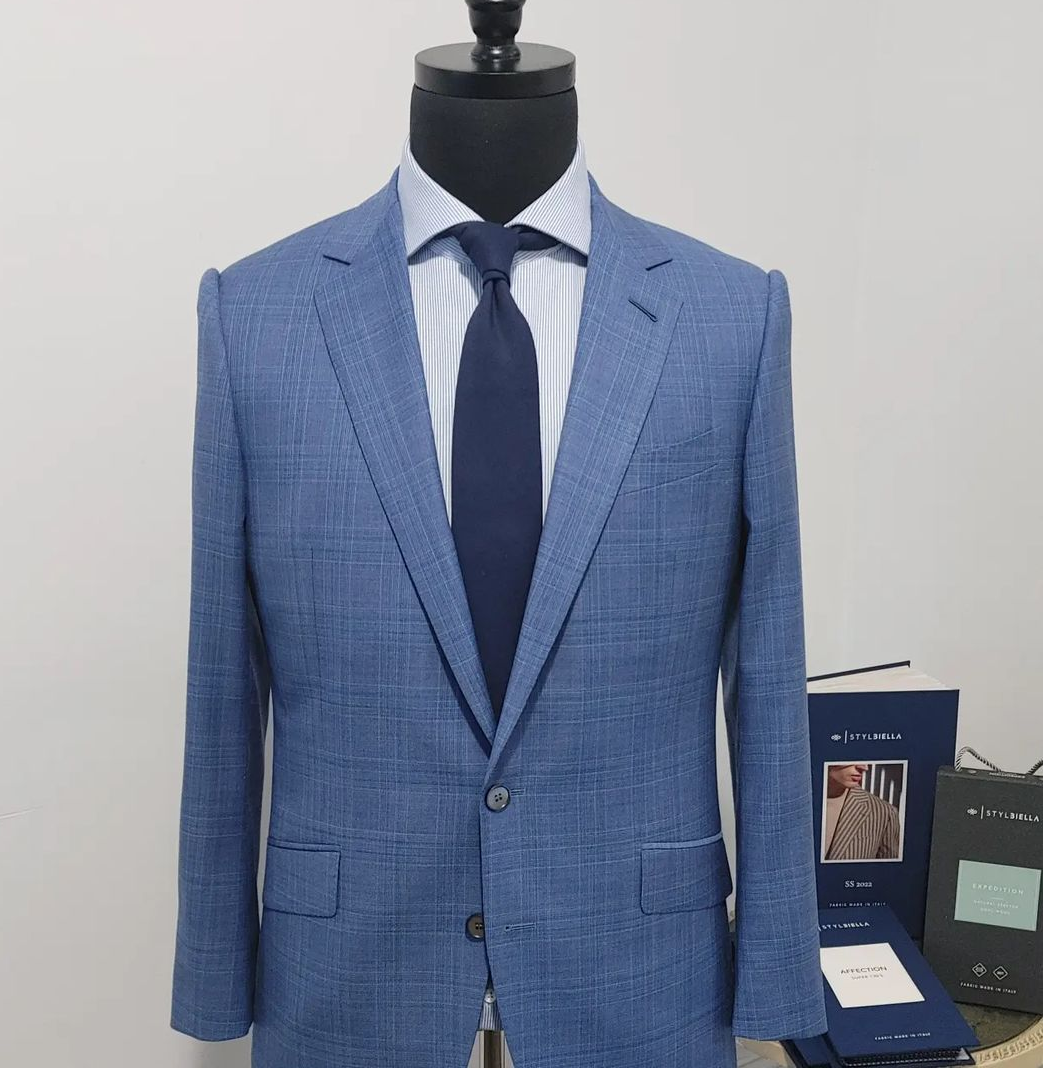
Double-Breasted vs Single-Breasted Suits A Complete Guide
Quick Answer
A single-breasted suit has one column of buttons and a narrow front overlap, making it the versatile default for business and formal wear. A double-breasted suit has two parallel columns of buttons with a wide overlapping front panel, creating a broader chest and a sharper, more commanding silhouette.
The short version: single-breasted is safe and adaptable; double-breasted is deliberate and structured.
Double-Breasted vs Single-Breasted: At-a-Glance Comparison
| Feature | Single-Breasted | Double-Breasted |
|---|---|---|
| Button columns | One functional column | Two columns (half decorative) |
| Front overlap | Minimal — edges nearly meet | Wide — panel crosses the torso |
| Standard configurations | 1-button, 2-button, 3-button, 3-roll-2 | 6×2, 6×1, 4×2, 4×1, 2×1 |
| Lapel style | Notch lapel (standard), peak on formal | Peak lapel (near-universal) |
| Vents | No vent, single vent, or double vent | Almost always double vents |
| Worn open? | Yes — unbutton when seated | No — keep fastened while standing |
| Waistcoat compatible | Yes (three-piece suits) | No — the overlap replaces it |
| Perceived formality | Business to formal | Formal and more fashion-forward |
| Visual effect | Lengthens the torso, slims | Broadens the chest, defines the waist |
| Best for | Every dress code, every body type | Presence, occasions, style-led wardrobes |
| Wardrobe priority | First and second suit | Third suit onward |
What Is a Single-Breasted Suit?
A single-breasted suit jacket has one column of buttons and front panels that meet with only a small overlap. It is the default construction for business suits worldwide and works across virtually every dress code, body type, and occasion.
Button configurations explained
| Configuration | Button Stance | Character | Best For |
|---|---|---|---|
| Two-button | Mid-chest | The modern standard | Almost everyone; interviews, business, weddings |
| Three-button | Higher | Traditional, more coverage | Taller men; classic and Ivy styling |
| Three-roll-two | Lapel rolls past top button | Soft, American classic | Relaxed tailoring, natural-shoulder cuts |
| One-button | Low, wide opening | Sleek and formal | Dinner jackets, tuxedos, evening wear |
The buttoning rule
Fasten the top button on a two-button jacket. Fasten the middle button on a three-button, with the top optional. Never fasten the bottom button — the pattern is drafted so that the bottom button pulls the jacket out of line when closed. Unbutton entirely when you sit down.
Why single-breasted dominates
It flatters the widest range of builds, layers cleanly under overcoats, works buttoned or unbuttoned, and accepts a waistcoat to become a three-piece. If you own three suits, at least two of them should be single-breasted.
What Is a Double-Breasted Suit?
A double-breasted suit jacket has two parallel columns of buttons and a front panel that crosses well over the body, secured by an inner “jigger” button that anchors the hidden side in place. Only one column is functional; the second is decorative and creates the signature symmetry.
The style descends from the naval reefer jacket, where the overlapping front sealed out wind and spray. It moved into civilian tailoring in the early twentieth century and became a status garment in the 1930s, largely through the influence of Edward, Prince of Wales later the Duke of Windsor whose wardrobe set the tone for a generation of tailoring.
Button configurations explained
The naming convention reads total buttons x fastening buttons.
| Configuration | Meaning | Character |
|---|---|---|
| 6×2 | Six buttons, two fasten | The classic. Balanced, timeless, most flattering |
| 6×1 | Six buttons, one fastens | The “Kent,” associated with the Duke of Kent. Deep V, elongating, rakish |
| 4×2 | Four buttons, two fasten | Compact and clean. Modern and less imposing |
| 4×1 | Four buttons, one fastens | Sleek, contemporary, low stance |
| 2×1 | Two buttons, one fastens | Minimal and fashion-forward |
Start with 6×2. It is the configuration that reads as a well-made suit rather than a costume, and it flatters the widest range of builds.
Why double-breasted looks the way it does
The overlapping panel adds visible width across the chest while the peak lapels draw the eye upward and outward. The result is a broader upper body and a defined waist — the reason the style has always been associated with authority.
The Six Real Differences That Matter
1. The overlap and what it does to your shape
Single-breasted panels meet with minimal overlap, creating a vertical line that elongates. Double-breasted panels cross the torso, creating horizontal breadth at the chest and a taper into the waist. One makes you look longer; the other makes you look wider on top.
2. Lapels
Single-breasted suits use notch lapels as standard, with peak lapels reserved for more formal cuts. Double-breasted suits use peak lapels almost universally a notch lapel on a double-breasted jacket looks unfinished to a trained eye.
3. Buttoning discipline
A single-breasted jacket looks correct open or closed. A double-breasted jacket must stay buttoned while you are standing. Unfastened, the front panel hangs loose and the whole silhouette collapses. Unbutton only when seated, and refasten before you stand.
4. Vents
Double-breasted jackets take double vents almost without exception, because the fuller front needs matching movement at the back. Single-breasted jackets work with no vent, one vent, or two.
5. Waistcoat compatibility
A three-piece suit requires a single-breasted jacket. The double-breasted overlap already covers the torso, so a waistcoat underneath adds bulk with no visual payoff.
6. Layering
Single-breasted jackets sit flat under an overcoat. Double-breasted jackets add material across the chest, which means your overcoat needs to be cut with that in mind something we account for directly when a client orders both.
Which Suits Your Body Type?
| Build | Recommendation | Reasoning |
|---|---|---|
| Slim or lean | Double-breasted 6×2 works beautifully | The overlap adds chest width and visual substance |
| Tall and slim | Either; 6×1 double-breasted is excellent | The deep V balances height without narrowing further |
| Broad or muscular | Single-breasted two-button | Avoids adding width to an already wide chest |
| Fuller midsection | Single-breasted two-button, or 4×2 double-breasted with a higher stance | A properly cut double-breasted can define the waist; a poorly cut one emphasizes it |
| Shorter stature | Single-breasted; if double-breasted, use 4×2 with a higher button stance | Keeps the button point high and the leg line long |
The honest caveat: double-breasted is less forgiving. On a single-breasted jacket, a fit error costs you a little polish. On a double-breasted jacket, the same error is visible from across the room the panel gapes, pulls, or hangs crooked. This is precisely why the style rewards custom work.
When to Wear Each
Wear single-breasted for
Job interviews, first client meetings, courtrooms, funerals, daily business wear, conservative industries, and any situation where you want your competence noticed before your clothing.
Wear double-breasted for
Board presentations, industry events, weddings as a guest or groom, cocktail receptions, evening functions, and any occasion where presence is part of the objective. It is also the stronger choice for men who already own several single-breasted suits and want their wardrobe to say something.
Fabric and Season
| Season | Single-Breasted | Double-Breasted |
|---|---|---|
| Spring | Super 110s–130s worsted, light flannel | Mid-weight worsted, hopsack |
| Summer | Tropical wool, fresco, linen | Fresco or high-twist wool avoid heavy cloth, the overlap traps heat |
| Autumn | Flannel, mid-weight worsted, subtle checks | Flannel and chalk stripe — the classic pairing |
| Winter | Worsted flannel, dense twill, Super 130s–150s | Heavier worsted, chalk stripe, birdseye |
Pattern note: chalk stripes and pinstripes suit double-breasted jackets exceptionally well because the vertical lines counterbalance the horizontal breadth of the overlap. Solid navy and charcoal are the safest entry point.
Why Fit Decides Everything Here
Double-breasted and single-breasted jackets are not the same pattern with different buttons. They are drafted differently from the first measurement.
At Executive Custom, a double-breasted jacket requires a longer front panel, a recalculated button stance based on the client’s torso length, precise placement of the interior jigger button, and a chest and waist balance that keeps the overlap flat rather than bowed. Get the button stance wrong by half an inch and the lapel roll breaks in the wrong place. Get the panel length wrong and the jacket flares open at the hem.
Our clients select from house fabrics and Italian mills including Loro Piana and Zegna, in weights from workhorse Super 110s and 120s through luxurious Super 130s–150s and ultra-fine Super 200s. Lapel width and shape, button configuration, stance height, vent style, pocket type, lining, and stitch color are all specified per garment which is how a double-breasted suit ends up looking made for you rather than borrowed.
With nearly 25 years of tailoring and alterations experience and a concierge service across New York, Great Neck, Dix Hills, and the surrounding areas, we take over 25 measurements before a single piece of cloth is cut.
Building Your Suit Wardrobe: The Right Order
- Navy single-breasted two-button — the universal suit; interviews, weddings, business
- Charcoal single-breasted two-button — the serious second suit; formal occasions
- Mid-grey single-breasted — daily rotation, lighter and more approachable
- Navy double-breasted 6×2 — your first double-breasted; solid or chalk stripe
- Patterned or seasonal suit — glen check, chalk stripe, linen, or flannel
Buy the double-breasted fourth, not first. It is the suit you wear when people already know how you dress.
Common Mistakes
- Leaving a double-breasted jacket unbuttoned while standing — the single most common error
- Choosing 6×1 as a first double-breasted — the deep V is striking but far less versatile than 6×2
- Pairing double-breasted with notch lapels — reads as an off-the-rack compromise
- Wearing a waistcoat under a double-breasted jacket — redundant and bulky
- Buttoning the bottom button on a single-breasted jacket — distorts the drape
- Choosing double-breasted in heavy cloth for summer — the overlapping panel doubles the fabric across your chest
- Assuming a tailor can convert one to the other — they are separate patterns, not an alteration
Frequently Asked Questions
Are double-breasted suits in style?
Yes. The style has moved firmly back into contemporary tailoring, particularly in navy and chalk stripe. Its formality has never fully lapsed it simply cycles between mainstream and specialist demand.
Should you always keep a double-breasted jacket buttoned?
Yes, whenever you are standing. The overlapping front panel is held in place by the buttons and an interior jigger button. Unbuttoned, the jacket loses its shape entirely. Unfasten only when seated.
Which is more formal, double-breasted or single-breasted?
Double-breasted generally reads as more formal and more deliberate. However, a single-breasted one-button dinner jacket outranks a casual double-breasted sport coat cloth and context matter alongside construction.
Can a short man wear a double-breasted suit?
Yes, with the right proportions. Choose a 4×2 configuration with a higher button stance and a shorter jacket length, and keep the lapels moderate in width rather than sweeping.
What does 6×2 mean on a double-breasted suit?
Six visible buttons in total, of which two actually fasten. The remaining four are decorative and create the symmetry of the front.
Can you wear a double-breasted jacket as a blazer?
Yes. A navy double-breasted blazer with grey flannel trousers is one of the strongest combinations in menswear. It should be made as a blazer, not orphaned from a suit.
Do double-breasted suits work with a waistcoat?
No. The crossed front panel already covers the torso, so a waistcoat adds bulk without any visible benefit. Choose single-breasted if you want a three-piece.
Is a double-breasted suit harder to fit?
Considerably. The overlap must lie flat, the button stance must match your torso length, and the balance must hold the panel closed without pulling. Small errors that go unnoticed on a single-breasted jacket are obvious on a double-breasted one.
Key Takeaways
- Single-breasted: one button column, minimal overlap, notch lapels, works open or closed, universally flattering
- Double-breasted: two button columns, wide overlap, peak lapels, must stay buttoned when standing, broadens the chest
- Start with 6×2 for your first double-breasted suit — it is the most balanced configuration
- Double-breasted cannot be worn with a waistcoat; single-breasted can
- Fit tolerance is far tighter on double-breasted, which is why it is a natural candidate for custom tailoring
Ready to Have Yours Made?
Whether you need a navy single-breasted suit that carries you through every dress code or a double-breasted 6×2 built to your exact stance and torso length, Executive Custom drafts each garment to your measurements, your fabric, and your intended use.
Book a consultation — in our showroom or at your home or office.
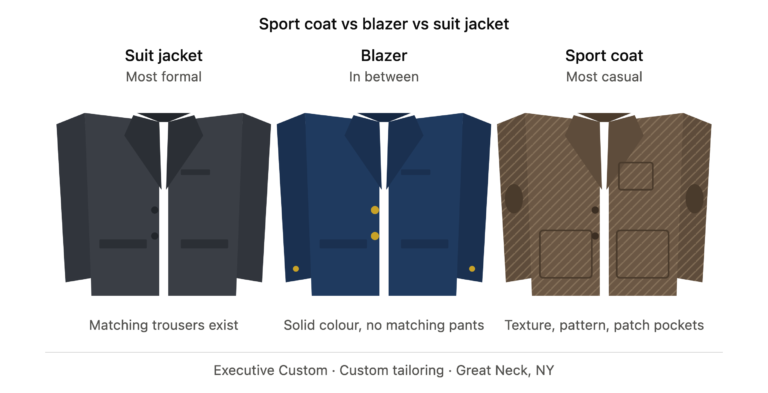
Related reading: Sport Coat vs Blazer vs Suit Jacket | Custom Suiting | Custom Clothing | Professional Tailor NYC | Bespoke Tailoring New York